
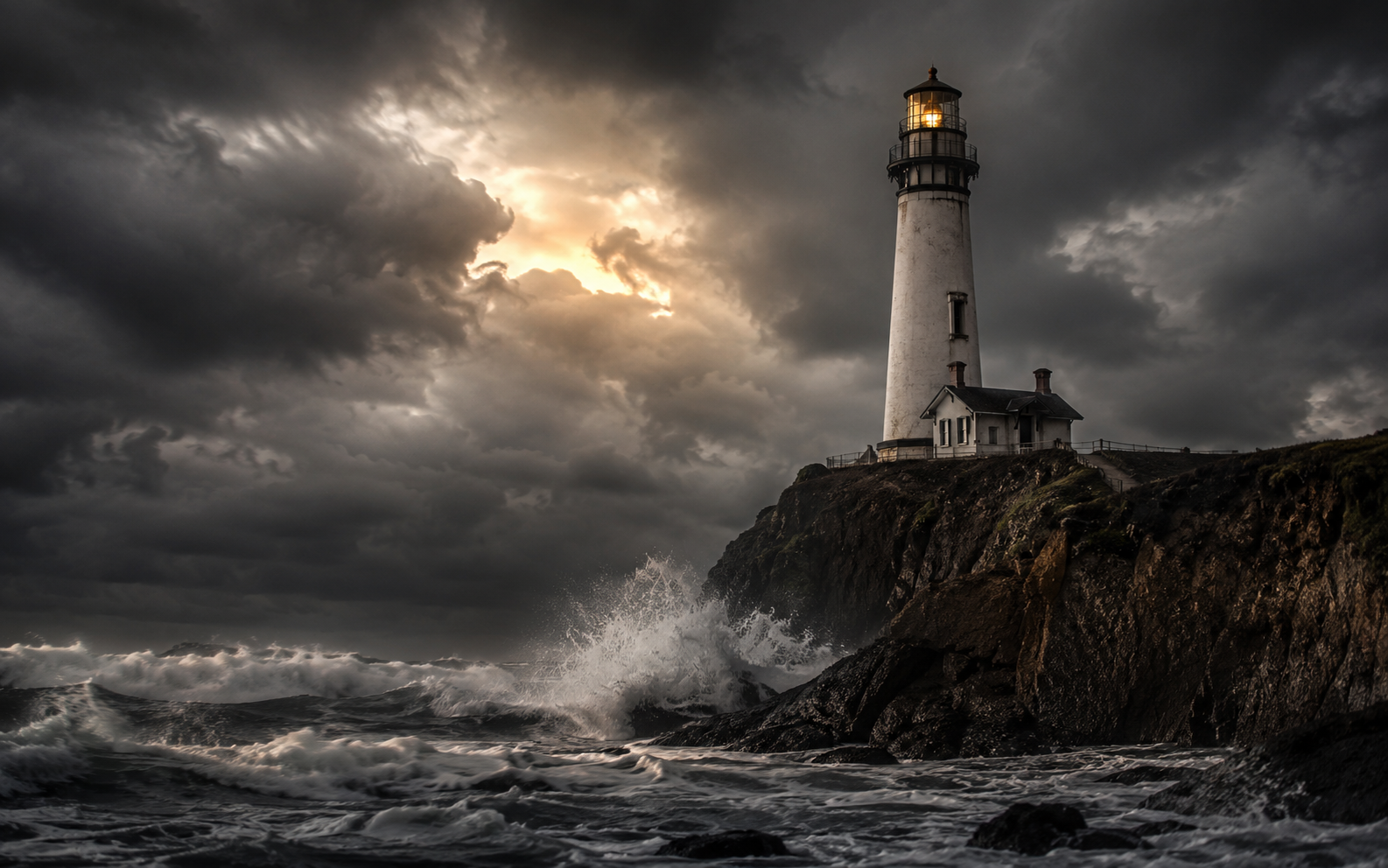
For most of maritime history, the lighthouse was the most important piece of infrastructure a coastline could have. A reliable light, in a known location, with a recognisable pattern of flashes, told a sailor exactly where they were and what they needed to avoid.
GPS has, for practical purposes, replaced this function. A modern ship can find its position to within a metre without ever looking at the shore. So why do most lighthouses still operate, and what do they have left to teach?
The original problem
The basic challenge of coastal navigation is that a coastline looks broadly similar from a few miles out at sea. Cliffs are cliffs. Headlands blur into each other. Without a clear identifying mark, sailors approaching at night or in fog had no reliable way to know whether they were about to enter the safe channel into a harbour or run onto rocks two miles further along the coast.
The lighthouse solved this by giving each piece of coast a unique, deliberately recognisable signature. Different flash patterns. Different colours. Different heights. A sailor consulting their chart could match what they saw — three white flashes every ten seconds — to a specific point on the map and know exactly where they were.
The principle of distinguishability
The deeper idea here is a principle that turns out to be useful far beyond navigation: things only help you locate yourself if they are distinguishable from other similar things. A million identical landmarks are useless. A few highly distinctive ones change everything.
Modern urban design has rediscovered this. Wayfinding signage works because each junction has a unique combination of name and direction. The history of lighthouse design is essentially a 2,000-year experiment in distinguishability — how do you make this point obviously different from that point, in conditions where almost everything looks the same?
What still goes wrong with GPS
GPS is reliable until it isn't. Tunnels, dense cloud cover, deliberate jamming, software bugs, dying batteries — there are dozens of ways the modern positioning system can fail. When it does, sailors fall back on the old methods: visual landmarks, compass bearings, dead reckoning, and the lighthouse.
This is why lighthouses are still maintained even though their primary role has technically been replaced. They are a backup system that does not depend on satellites, software, or electricity from anywhere except its own generator. In an emergency, the principle works just as well in 2026 as it did in 1826.
The lighthouse as cultural object
Beyond navigation, lighthouses have become a particular kind of cultural symbol — solitary, persistent, watchful. There is a reason they appear in so many novels, poems, and films. They are a physical embodiment of the idea of a fixed point that helps others orient themselves.
This is not a metaphor that needs much explanation. A lighthouse stands still in dangerous conditions so that other people can find safety. It does not move. It does not need attention. It simply burns.
The few that still need keepers
Almost all lighthouses are now automated. A handful, in particularly difficult or symbolically important locations, still have keepers — a role that has become more about heritage than practical necessity. Visiting one of these is one of the strangest tourism experiences available: you arrive at the most isolated possible workplace and find someone whose job is to keep the light on for ships that probably no longer need it.
The job will eventually disappear entirely. The lighthouses themselves probably will not. They are too useful as a backup, too charged with meaning as a symbol, and too beautiful as architecture to take down.